Monticello

The Fortress
Most people think of it as my home. It was but it was also designed to be the alternate seat of US Government in an emergency.
It was also an impregnable fortress. Other homes in the area were also forts so the entire government could be housed in an emergency. These buildings include the George Divers House which was built
for the House of Representatives to stay at. Even the White House itself was a fortress under the
facade of being a home. (See page 2 for
these other buildings)
First let me take you on
a tour of the secrets of Fort Monticello.
There
is nothing stranger about Monticello than it's size.

No,
those people outside it are not later day munchkins looking for Dorothy. They are regular sized people. However, many visitors
begin to wonder if they might be munchkins as they approach the house. Notice
that the man touching the pillar is bald and has a beard, so you know for a fact that
they aren't children.
Monticello
appears to be a single story house but it is a two story house, plus
the dome on top.
Appearing
as though it was only one story was better than all the other defenses
combined. It is a grand optical illusion. This next picture I've made
to show how this optical illusion would have worked if Monticello had
been attacked.

At any range Monticello appears to be only half the distance that it really is. Thinking that Monticello was
only about ten feet high (plus the dome) any enemy gunner firing at Monticello would set the
elevation of their gun for half the distance. Every shot they fired would
then fall short of the target.
 Each
window extends up to include the second floor and also functions as
a low window for the second floor rooms. It is easy to see on the side
of the house where one of those large windows was later made into two windows. American soldiers could fire from the second floor in the prone position and the enemy would think that he was firing from the standing position on the first floor. The enemy would miss every time.
Each
window extends up to include the second floor and also functions as
a low window for the second floor rooms. It is easy to see on the side
of the house where one of those large windows was later made into two windows. American soldiers could fire from the second floor in the prone position and the enemy would think that he was firing from the standing position on the first floor. The enemy would miss every time.

The
English were known to use poison so you can probably imagine two English
agents with ten pounds of arsenic powder sitting on the bench in the
back saying to each other. 'We need to put the poison in the cistern. I wonder where it is? It's supposed
to be near here.'
The
cistern was actually the square 'post' under that pagoda on the left.
The cistern was originally a pedestal for a statue. We had different statues at different
times according to whether or not war was threatened. During the War
of 1812 a statue of a mounted colonel made of hollow brass was used
and it was not one tenth as heavy as it looked. It was very convincing,
especially with all the soldiers who automatically would show respect because it was an 'officer' and leave it alone.
 The
Thomas Jefferson Foundation states:'The purpose of the Dome Room
is not revealed in any of Jefferson's surviving papers.'
The
Thomas Jefferson Foundation states:'The purpose of the Dome Room
is not revealed in any of Jefferson's surviving papers.'
Well
it was a secret. There was no reason to give a false purpose for it.
The eight round windows were for the two large ships cannons that were put
in there in time of war. Each cannon had a 45 degree field of fire.
That meant a 360 degree field of fire. The floor now is covered with a layer of weak wood but under that layer there
still should be another two layers, 6-8", of hard wood as strong
as any ship's deck. It was to handle the weight of the guns. I can't recall off hand what the top layer
was made of. I think oak. It may have been stripped in the last 180 years but I have no way of knowing what has happened in the intervening years.

We
used to call it the 'dumb room' instead of the 'dome room' because it
just sat there doing nothing which was pretty stupid. Once it is pointed
out to you that there is not even any inside stairs you'll agree
that makes it an even dumber room. (There are not any stairs because you
couldn't move cannons around much or they might fall down the stairs.)
The
actual dome itself was thin and held into place by a few simple pegs. It could
be lifted off by a dozen men or pushed off the house by three men. That
way the men inside wouldn't become deaf when they fired the cannons.
Also, there were often four mortars stationed up there that could shoot out
through the top.
Each
cannon (demicannon?) weighed over 4,000+ pounds and used a 32 pound
cannon ball or grape shot with full charges. Later 48 and 64 pound cannons
were installed. Those cannons could keep any cannon that the English
fielded at the time from ever getting even near enough to shoot a cannon
ball to within a mile of Monticello.
Somebody
could make me out a liar really fast if they determined the floor to be
a standard one inch thick floor. (And I wish they would so that I could dismiss this and do something more fun.) It should be the original floor unless the confederates
who took over the house destroyed it (like they probably did to the
main stairs, see below) Also, treasure hunters may have
thought it had treasure in it since it was thick and they may have taken that floor apart.
Thick wood pieces and wood beams were often hollowed out and made into
safes. They usually did it from the end of a rough hewn log since a
plug could be made to match the wood more easily than the sides which had to match
the visible grain of the planed wood.

This was the
most ideal location for any fortress. Just ask any officer. The top of a hill with a 360 degree
view of the surrounding area which was clear for many miles. You can't get any better than that.
Monticello
stairs.
It is said
that there are only two narrow stairs at each end of the house. Those
were for fire escapes and so was the iron spiral staircase that was mounted on the outside of the back wall which I
assume is not there anymore. We had to have numerous emergency staircases. The visitors would sometimes take the occasion
of a visit to declare independence from normal teetotal behavior and
get smashed. Then fires that normally stayed in fireplaces or in lamps could easily spread to the entire house .
.
There was
at least one staircase in the front room (right) which is now missing.
You can take
a closer look at it here.
I'm sure the stairs must be on some of the early drawings and house plans.
That balcony
and the wings which extend out look pretty naked without any stairs and they
are pretty useless the way it presently is. What purpose could those wings
possibly serve?
A cat would
love to sit up there and stare down at visitors but almost anything having
to do with a cat is pretty useless. So I guess that conclusively proves
my point.
Thomas Jefferson
never harbored 'useless' in his life.
The stairs
sat on pegs or brackets that were mounted in the wall. Then the stairs
could be pulled up on the landing above it in case there was a siege of Monticello
and the invading soldiers had made it inside the house. That would isolate the upper levels of the house from
the first floor except for the narrow stairs at the ends which had gates
at one time and were easily defended in any case. Bombs (grenades) and
boiling oil could be dropped on any enemy that had made it inside Monticello.
 I am pretty
certain that the stairs were similar to these on the left. There was a few steps
up, about two feet, along the front wall and then it turned 90 degrees
and went up to the landing above (the one with the cat).
I am pretty
certain that the stairs were similar to these on the left. There was a few steps
up, about two feet, along the front wall and then it turned 90 degrees
and went up to the landing above (the one with the cat). 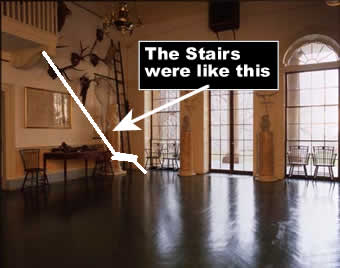
The stairs
were made on split logs or rough hewn boards that ran lengthwise. This
gave rigidity to the stairs.
Since the
stairs were probably on pegs it was very easy for some lazy person to have stolen those stairs and use them in another house. They were very
sturdy (as you could drag a four pound cannon up them) and possibly they
were used in a house somewhere nearby or in Charlottesville that was
built in the 1800's. However, for all I know someone (like an invading Confederate soldier) could have used them for firewood.
This is not as ridiculous as it may sound to you. It certainly would not be if you knew the history of the house after I died. It was not only taken over by the Confederacy but it was also abandoned for a while. At another time it was striped. I am not going to go over it all because it is not the point of this paper. However, you can read about it elsewhere if you want to.
The key to finding out if you happen to be the person who has Jefferson's stairs in your Charlottesville house is
on the underside of the stairs at about the level a seven year can reach. That is
where a name is carved (she may have been a niece). Indelible are both
her carved name and the memory of how happy and how very proud she was
of her skills as she stood there beaming in her blue dress. However
some of us were not nearly as happy as she was about her
new found skill. I recall it clearly. I think this tiny incident kind of amazed me that she had gotten at least the first five letters
of 'Jefferson' spelled right. For some reason Jefferson is a very difficult
name for small children to learn to spell.
The
brick used on Monticello were special made and are probably still the
hardest brick obtainable. It could stand up to any weapon in
use at the time. It could withstand direct hits at point blank range
by all cannons that England fielded in North America. The most often used
was the 6 pounder and the wall could handle four repeated strikes in
the same location or a single hit by 9 pound cannon at point blank range.
At 1000 yards nothing the English had in the field, even a 24 pound cannon,
could dent or chip the wall.*
Snipers
could also be assigned to use the second floor and nobody ever shot
at the top of a window in a one story home so the snipers were safe
twice over..
Each
year the Army Artillery experts and this meant a lot of generals who
fought in the Revolutionary War came and tested the entire system and
simultaneously trained the militia (and some cadets from West Point). This included
setting up and using all the cannons with full charges and cannon balls. Massive improvements in artillery were coming
about due to the European wars. Each arriving cannon also had to be
fired to determine it's accuracy and range. The Corps
of Artillerists and Engineers did the set up and testing. Then as
West Point got underway (before and during the War of 1812) both instructors
and cadets were trained to use the cannons at Monticello. They were to
be the defenders of Monticello. To conceal this secret they used the
code name 'Manhattan' or 'Manhattan Fort'. The practice was often done in
the winter since snow would muffle the noise and the impacts would usually
result in a spray of mud, dirt and snow which could easily be seen.
At
first we couldn't find a clear strip of land to shoot at in order to
sight in the cannons and determine their ranges. We tried shooting into
land that was partially covered with trees but often you could not tell
where the cannon balls hit when they went into the trees. (Later after
1800 there was one long field but it had cows in it and even if we didn't
hit one of them they all stopped giving milk for a week.)
There
had been complaints from the good people in Charlottesville about the
noise from the cannon fire. They had a legitimate complaint since cannon
fire makes everyone nervous except the Generals. It woke up people who
were taking naps and a baby cried once. When they all said that the birds
stopped singing I realized that they were all members of the town church.
Maybe
it was General
(ret) John Stark (the 'fighting parson') who proposed just shooting
on Sunday mornings but that was real limiting for us. The church members
talked it over and gave us four hours on Sunday mornings which was not
nearly enough time. That did help us enlist local men since those who
like to shoot cannons were usually those same men that were aching for any
excuse to get out of going to church.
It
was fine with the church members or as one woman stated with a wry and
strange smile 'I certainly don't mind if you kill a few people who should
be in church', which meant the 'playboy' widower Thomas Jefferson. I
trained the citizens to not only appreciate my poignant and wry sense
of humor but I also seem to have taught them how to emasculate me by using the same brand.
 The
preacher saw immediately that it would solve all attendance problems
and with a more captive audience for hours on end it gave him an excuse to
pile on more hell, fire and brimstone while we provided the thunderous
wrath. Then the church members had a social afterwards for the rest of the four hours.
Often we would join them at those socials.
The
preacher saw immediately that it would solve all attendance problems
and with a more captive audience for hours on end it gave him an excuse to
pile on more hell, fire and brimstone while we provided the thunderous
wrath. Then the church members had a social afterwards for the rest of the four hours.
Often we would join them at those socials.
For the cannons we
needed a place clear of trees for from 3 -5 miles away from Monticello. George Washington
was the gunner in charge. He said 'what about that old road over there'.
(The road now known as Garth Road was considered old even 200 years
ago.
I
said 'Oh no, that's clear on the other side of Charlottesville'. I had
endured their wrath once and that was enough. The visiting Generals could go home but
I had to live there, so I made it perfectly clear as I looked at Charlottesville.
'We would have to shoot right over the exact center of town and the
courthouse
(which on Sundays became the church).
George
and I just slowly turned to each other with huge grins on our faces.
He then bent over to sight the cannon and simply said 'Which building
is that whorehouse?' (This had nothing at all to with the church. He
always referred to the entire legal establishment with such disrespect.
He thought the local court near him was established to take his property away
from him. It was! George's political opponents when they got into power
rezoned districts or moved the county lines and then quickly built a
'whorehouse' just so they could pack it with their own people every time. This disturbed him greatly
and he often made very poor judicial appointments as a result of this unfairness. One of them was
John Rutledge who I write about on this page.
)
Since
the cannons were pointing at them when they went off, the good citizens of Charlottesville, over 2 miles away, sitting
in church, got an even louder explosion from Monticello than before. This was followed by
a loud wooshing sound as the cannon ball passed overhead.
On
the map you can see the road which is now called Garth road on the other side of town running
north west and straight out of Charlottesville. For three miles to six miles from Monticello you can clearly see that it was a fairly 'straight
shot'. At four miles out we had someone place a bed sheet in a tree by the
road to determine the near maximum range for the large cannons.
We had three farmers on the look out for cannon balls to make sure they
got pushed off the road before people saw them after leaving church.
We
always tested each barrel of gunpowder each Sunday. I first tested it when George
first opened it. Then George Washington tested independently
using a different method. The complicated method involved a column and
the displacement of air by the expanding gas which evolved from the
burning of a certain amount of gunpowder.
Most people know how the proof of alcohol was determined. If you wet
gunpowder with liquor and it burned then it was over 100 proof but many people
don't know that this test was also used the other way around, as a simple test for gunpowder.
We had lots of bottles with eyedroppers. I had a big range of them.
If it took more than 120 proof alcohol to burn the gunpowder then those
people only two miles away in the 'courthouse' church would have been
in danger. This test was mostly used by armies, right before firing,
in the field to make certain the powder wasn't wet.
We
also had planned to mount a 54-57 pound cannon in the front room to
shoot right out the front door but it was never obtained or needed.
Snipers could also use the large dome holes but they could best use the
second floor and also that low railing in front of the dome room (up here on this page). At the time the railing
was taller and had a different design. The rail was not like the one
there now with lots of spaces. The men could safely shoot through the
narrow slots of the old rail which were spaced at least a foot apart.
Monticello
had several tunnels that were initially made to be used for bringing
in relief if the English (or French, Germans, etc.) surrounded the place. Alternately
these tunnels could be used for escape if all else failed. One tunnel went to
the hill where a man with a spyglass (telescope) acted as a lookout for
any approaching enemy.
 This
is not the original tower, nor was it the only one. There were several so called 'observation towers'
which were place where there were good views so that you could sit and drink tea.
Except that they were not located for the views as such. Three were placed
in the most strategic observation points possible to be able to see
any enemy troop activity and to be able to relay firing orders for the cannons.
There was a tunnel that went to it and I think it was under it.
This
is not the original tower, nor was it the only one. There were several so called 'observation towers'
which were place where there were good views so that you could sit and drink tea.
Except that they were not located for the views as such. Three were placed
in the most strategic observation points possible to be able to see
any enemy troop activity and to be able to relay firing orders for the cannons.
There was a tunnel that went to it and I think it was under it.
 This
is one of the tunnels under Monticello and as you can see it is very
well constructed. These are identical to those in many U.S. forts at
the time. They are not the makeshift type of tunnel which many people
would expect to find.
This
is one of the tunnels under Monticello and as you can see it is very
well constructed. These are identical to those in many U.S. forts at
the time. They are not the makeshift type of tunnel which many people
would expect to find.
Greased
boards were placed on the floor to create a smooth surface to allow
the moving of the very heavy cannons (about four tons) with fair ease.
Some
of the other tunnels acted as bunkers to store cannon during the revolution. These were
to be used on the ground in front
of Monticello but they
were never needed. There were steel tracks in some of the tunnels for the cannon
but they are probably not there any longer. At least one tunnel was later used to go a latrine in
the winter time as described
here. That was the guest latrine I referred to in 'Trinkets
in Monticello' which is on the next page. There are lots of mentions of tunnels on the
Thomas Jefferson Foundation website but I'll finish the subject with
this: They appear to have located approximately only one tenth of
the tunnel system that existed under Monticello 200 years ago.
Page
2
*The
English did bring in larger cannons and by 1800 they had a much more
powerful cannon, so don't confuse those cannon with the ones that the English used when
Monticello was built. However, they never would have gotten those within
sight of Monticello
Previous
Page
All rights reserved. ©
J Pinil, Inc. 2004-10


